At a glance
- Our kind of strange friend
- Lake-monster legend
- Story connection
- Loch Ness, Scotland
A closer look at the story
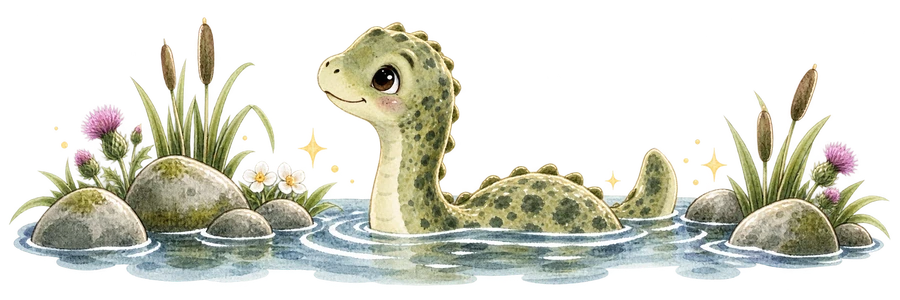
Nessie has not always had the same shape. Earlier accounts described something more like a whale or eel. The long-necked image became familiar in the 1930s, helped by the famous “Surgeon’s Photograph.” That photograph was a hoax.
Dates to put in your notebook
- 1930sThe familiar plesiosaur-like image of Nessie took hold.
What the evidence tells us
Plesiosaurs were real prehistoric reptiles, known from fossils. They died out about 66 million years ago; searches at Loch Ness have not found a living one. A resemblance in a drawing does not make Nessie a surviving plesiosaur.
Your turn to investigate
Imagine a dark shape on water. What would knowing its size, movement, and distance help you work out?
Where these notes come from
Grown-ups can view sources in the Parent Area.
- Natural History Museum · Plesiosaurs and Nessie
Fossil history, changing descriptions of Nessie, and the photograph hoax.
Notes checked September 2026.
A home that fits
A habitat is the place where an animal lives and meets its needs. Northern river otters hunt fish and other prey in water, but use dens along the shore. Water alone is not their whole home.
Try noticing
Look at the water, shelter, and space around an animal. What might it need here?
- National Park Service · Watching wildlife
- Isle Royale National Park · Northern river otter
From legend to storybook
Goodbye Nessie brings this friend into an imaginative story about loving, growing, and letting go.
Read Goodbye NessieSomething to look at closely
Keep a storybook clue, then see how a naturalist might interpret it.
Open this friend’s notebook page →
A little research envelope. What is tucked inside?